How to Find Your Ring Size at Home (Sizes 4-15)
Wrap a strip of string or paper around the base of your finger, mark where it overlaps, and measure the length in millimeters. Match that circumference to a US size chart (4 to 15). For silicone rings, size up if you fall between sizes, and measure when your hands are at normal temperature.
Why does the right ring size matter?
A ring you can barely get on is annoying. A ring that spins loosely or slides off is worse. Getting your size right before you order saves a return, a delay and, if the ring is a gift, an awkward conversation. The good news is that you do not need a jeweler. Everything below can be done at a kitchen table with a ruler.
This guide covers five ways to measure, a full chart for US sizes 4 through 15, and specific advice for silicone rings, which behave differently from metal. We make 3D silicone sports rings at Gameday Global, so we focus on the practical questions that come up most when people order a ring for themselves, a teammate or a fan in the family.
One thing to keep in mind from the start: your ring size is really a measurement of your finger, converted into a number. If you can get a clean measurement of the finger in millimeters, you can find your size on any chart. That is what every method below is trying to do.
What do US ring sizes 4 to 15 actually measure?
A US ring size is a way of describing the inside diameter, or the distance across the opening, of a ring. Each full size step is a small, consistent change in that diameter. A half size is half of that step. The sizes in this chart are the widely used standard conversion, calculated from the inside diameter and rounded to one decimal place.
You will see two numbers people measure. Circumference is the distance around your finger, which is what you get with string or paper. Diameter is the distance across the inside of an existing ring. Both lead to the same size, so use whichever method is easier.
| US size | Inside diameter (mm) | Inside circumference (mm) | Circumference (inches) |
|---|---|---|---|
| 4 | 14.9 | 46.8 | 1.84 |
| 5 | 15.7 | 49.3 | 1.94 |
| 6 | 16.5 | 51.9 | 2.04 |
| 7 | 17.3 | 54.4 | 2.14 |
| 8 | 18.1 | 57.0 | 2.24 |
| 9 | 18.9 | 59.5 | 2.34 |
| 10 | 19.8 | 62.1 | 2.44 |
| 11 | 20.6 | 64.6 | 2.54 |
| 12 | 21.4 | 67.2 | 2.64 |
| 13 | 22.2 | 69.7 | 2.75 |
| 14 | 23.0 | 72.3 | 2.85 |
| 15 | 23.8 | 74.8 | 2.95 |
Use the circumference column if you measured with string or paper, and the diameter column if you measured an existing ring. Different charts can differ by a fraction of a millimeter because of rounding, so treat the nearest match as your size rather than expecting an exact hit.
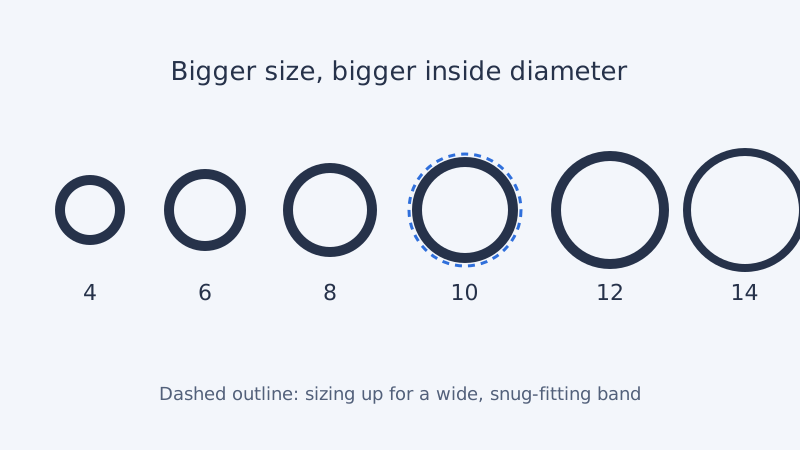
If your measurement falls between two rows, do not panic. Half sizes exist for a reason, and the section on silicone rings explains which way to lean.
How do you find your ring size with string or paper?
This is the classic method, and it is the one most people can do in two minutes with items already in the house. It gives you your finger circumference directly.
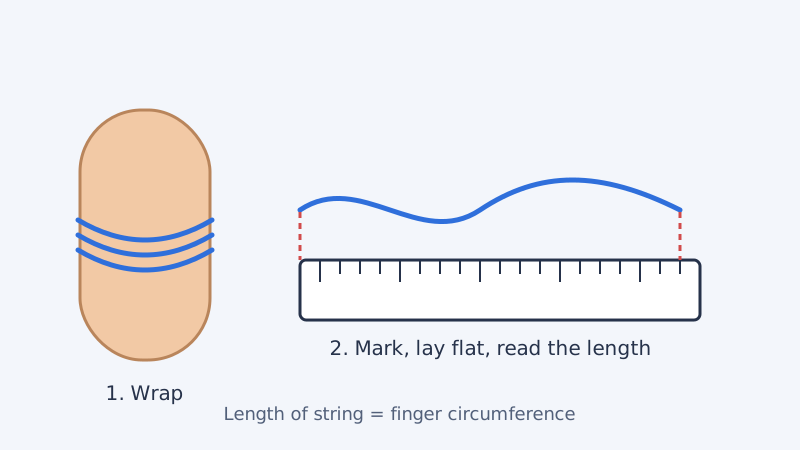
- Cut a strip. Cut a strip of paper about 6 mm wide and 15 cm long, or take a piece of non-stretchy string or dental floss about 15 cm long.
- Wrap it around the base of the finger. Wrap the strip once around the base of the finger you plan to wear the ring on, snug but not tight.
- Mark the overlap. Mark the exact point where the end meets the rest of the strip with a pen.
- Measure the length. Lay the strip flat against a ruler and read the length in millimeters. This is your finger circumference.
- Match it to the chart. Find the nearest circumference in the size chart above. If you land between sizes, read the section on sizing silicone rings below.
What to use for the string
Choose something that does not stretch. Dental floss, thin ribbon, a strip of paper or a narrow piece of sticky note all work well. Yarn and elastic thread can stretch or compress and give you a number that is too small or too large. If you only have stretchy material, pull it gently and consistently, and repeat the test a few times.
Where on the finger to wrap
Wrap at the base of the finger, where a ring would normally sit, not at the knuckle or the fingertip. Keep the strip flat against the skin and avoid twisting it. If the strip bunches or overlaps itself unevenly, start over. Neatness matters more here than speed.
How does the printable ruler or size gauge method work?
A printable ring sizer is a page of circles or a strip with a size scale that you print at home. You either hold a ring against the circles, or wrap the paper strip around your finger and read the number. It is a handy method because it gives you a direct size without any math. Its weak point is print scale, so the setup matters.
Print it at the correct scale
Before you measure anything, print the page at 100% or "actual size". Turn off "fit to page", "shrink to fit" and any automatic scaling. If you print from a phone, use the print preview and look for a scale setting.
Calibrate with a known object
After printing, hold a real ruler against the printed ruler and confirm that the millimeter marks line up. A standard credit card is another easy check, since it is about 85.6 mm wide. If your printed scale is off, change the settings and print again. Never measure with a gauge you have not checked.
Two ways to use a printed gauge
- Circle chart: Place a ring you already own on the printed circles and find the circle that matches the inside edge of the ring. Do not match the outside edge.
- Strip gauge: Cut out the strip, wrap it around the base of your finger, and read the number at the point where the end passes through the slot or lines up with the scale.
If you do not trust your printer, you can skip the printed gauge entirely. Measure your finger with string or paper, read the length on a real ruler, and use the chart earlier in this guide. It gives the same answer.
Can you measure a ring you already own?
Yes, and for many people it is the most reliable method of all, because it uses a ring that you know fits the way you like. The key is to use a ring that fits the same finger you are sizing for, and that has a similar width to the one you want to buy.
Measure the inside diameter
Lay the ring on a flat surface and measure straight across the inside, from one inner edge to the opposite inner edge, at the widest point. Do not include the thickness of the band. Compare your reading to the diameter column in the chart.
Or measure the inside circumference
Lay a strip of paper along the inside of the ring, mark where it closes, and measure the strip. Compare that length to the circumference column.
Keep the band width in mind
A narrow ring can feel fine at the same size where a wide one feels tight. If your reference ring is thin and the ring you want to buy is wide, plan to go up. If your reference is also wide, you can match the size directly.
How do finger width, knuckles and shape change the answer?
Fingers are not uniform tubes. Many people have knuckles larger than the base of the finger, and some have the reverse. A ring has to pass over the knuckle and then sit at the base, so the best size may be a compromise between the two measurements.
Measure both the base and the knuckle
Take one measurement at the base and another around the widest part of the knuckle. If the knuckle measurement is larger than the base by a lot, the ring may be hard to put on at the base size, or it may spin once it is on. A flexible silicone ring can stretch a little to pass the knuckle, which helps, but you should still check both numbers.
Think about the width of the band
A wider band covers more of the finger and grips more skin, so it feels snugger than a narrow one in the same size. That is why many sizing guides suggest going up a half size or a full size for wide bands. Our rings are chunky, 3D designs, so we treat them as wide bands for sizing purposes.
When and in what conditions should you measure?
Fingers change slightly during the day. They can look a little smaller when they are cold and a little larger when they are warm, after exercise, or later in the day. That is normal, and it is why one measurement taken at a bad moment can lead you to the wrong size.
- Measure at a comfortable temperature. Avoid measuring right after coming in from the cold or stepping out of a hot shower.
- Measure more than once. Take readings on two different days, and at two different times of the day, then compare.
- Avoid extremes. Do not measure right after heavy exercise or if your hands feel unusually puffy or tight.
- Relax your hand. A clenched or tensed hand can change the reading, so keep it loose and natural.
How do you size a silicone sports ring?
Silicone rings are not the same as metal rings, and the difference affects how to size them. A metal ring has a fixed shape and cannot stretch, so a size that is slightly off is noticeable right away. A silicone ring is soft and flexible, and it gives a little as you put it on and take it off. That makes the process more forgiving, but it does not remove the need to measure.
Start with your measured size
Use the chart earlier in this guide to find the US size that matches your finger. Our rings are offered in sizes 4 through 15, so you can order the size you measured without rounding to a limited range.
If you are between sizes, size up
This is our general guidance for silicone. A ring that is a little roomy is generally easier to live with than one that feels tight, especially for a chunky 3D design that has more material than a thin band. If you wear a wide band, or your knuckle is larger than the base of your finger, the larger size is usually the better choice.
Think about how you will wear it
If the ring is mostly for game days, a fan gift or a collection, a comfortable fit matters more than a precise one. If you plan to wear it during active play, you may prefer a size that stays put without being tight. In both cases, a comfortable fit when your hands are warm is a good target.
Keep the shape in good condition
How you look after a silicone ring also affects how it fits over time. Our guide to how to care for silicone rings covers cleaning and storage, and our comparison of silicone vs metal sports rings explains why silicone sizing feels different from metal.
Not sure? Ask us
If you have measured and still cannot decide between two sizes, email [email protected] with your measurement in millimeters and which finger it is for. We will tell you which size we would pick. You can browse the full range of football, baseball, softball, basketball, soccer, golf and volleyball rings at gameday.best.
How do you size a ring as a gift or for a team?
Sizing for someone else is the hardest case, because you cannot measure their finger directly. There are a few good ways around it.
Borrow a ring
If the person wears a ring on the same finger, borrow it for a few minutes, or ask them to leave one where you can reach it. Trace the inside on paper, or measure the inside diameter and compare it to the chart.
Ask someone close to them
A parent, partner or friend may already know the size, particularly if they have shopped for rings before. Ask casually, and ask which finger it applies to.
Go for the middle of the range
If you cannot find out, choose a mid-range size for the person's likely hand size and lean slightly larger. For a flexible silicone ring, a slightly generous size is more forgiving than one that is too small. Our guide to the best sports gifts for fans has more ideas if you are shopping for a particular fan.
Buying for a whole team
For a team, you can simply ask each player to measure with string or paper and send you a number, or have them try on a sample. Collect the sizes in a simple list with each name and finger. That works for a youth team, a league or a group of fans.
What should retailers and team organizers know about sizing?
If you sell rings in a shop, at a stadium stand or through a team fundraiser, sizing is the main thing customers ask about. A small printed size card at the counter, with the string method explained in two lines, answers most of those questions before they come up.
Gameday Global offers wholesale pricing from $9.00 per ring on a starter case that includes a free countertop display, with $8.00 per ring on five or more cases. Orders placed by November 6, 2026 are intended to arrive in time for Black Friday. Details are at gameday.best/wholesale, and you can email [email protected] with questions about the size mix that suits your customers.
Key takeaways
- Your ring size is a conversion of your finger measurement, so get a clean measurement in millimeters first.
- String, paper, a calibrated printable gauge and an existing ring all lead to the same chart.
- Check your print scale at 100% against a real ruler or a credit card before trusting a printed gauge.
- Measure the exact finger, at a comfortable temperature, and repeat on a second day.
- Check both the base and the knuckle, because the ring must pass one and sit on the other.
- For wide or chunky silicone rings, size up if you are between sizes.
- When unsure, email [email protected] with your measurement and finger.
Frequently asked questions
What size is a normal ring for adults?
There is no single normal size, because hands vary widely. Our silicone sports rings come in sizes 4 through 15, which covers small children's fingers through large adult hands. The only reliable way to know your size is to measure the finger you plan to wear it on, using string, paper, a printed gauge or a ring you already own.
Should I size up or down for a silicone ring?
If you fall between two sizes, we suggest the larger one. Silicone is soft and flexible, but a ring that is too snug is uncomfortable, while one that is a little roomy can still be worn comfortably. If you wear a wide band, a half size larger is usually the safer choice. When in doubt, email [email protected].
Is the string method accurate?
It is accurate enough for most people when you use non-stretchy string or paper, mark the overlap precisely and measure against a real ruler. Errors usually come from stretchy thread, wrapping too tightly or measuring in a hurry. Repeat the measurement two or three times, and use the middle result if the readings differ slightly.
When is the best time of day to measure my finger?
Measure when your hands are at a comfortable, normal temperature, ideally in the afternoon or evening rather than right after waking up or coming in from the cold. Fingers can look slightly smaller when they are cold and slightly larger when they are warm, so repeat the measurement on a second day.
Which finger should I measure?
Measure the exact finger the ring will go on. Fingers on the same hand are different sizes, and your dominant hand is often slightly larger than the other. Many people also need a different size for each hand. Write down which finger and which hand each measurement belongs to.
How do I measure a ring size for someone else as a gift?
Borrow a ring they already wear on the right finger and measure its inside diameter, or trace the inside of it on paper. You can also ask a family member or friend who knows their size. Avoid guessing from clothing sizes. If you are still unsure, choose the middle of the likely range.
Does the printable ruler method work on any printer?
It works if the page prints at 100% scale. Turn off any fit-to-page setting, then check the printed ruler against a real ruler or a standard credit card, which is about 85.6 mm wide. If the measurements do not match, adjust your print settings and print again before using the gauge.
About the author
Scott Tischler is the Owner of Gameday Global, which makes 3D silicone sports rings in football, baseball, softball, basketball, soccer, golf and volleyball designs, in sizes 4 to 15, at $29.99 each on gameday.best. Retailers can see wholesale terms at gameday.best/wholesale.