Sports Rings for Athletes: What to Wear, What to Check, and How to Wear Them Every Day
By Scott Tischler, Owner, Gameday Global · Published
What are sports rings, and why do athletes wear them?
A sports ring is a ring made to represent a sport rather than a precious metal or a gemstone. The Gameday Global rings, for example, are 3D silicone rings shaped and colored to look like a football, baseball, softball, basketball, soccer ball, golf ball or volleyball. They come in sizes 4 through 15, so they fit most hands from younger players to adults.
Athletes wear them for the same reasons people wear any piece of personal jewelry: identity, memory and fun. A ring can say "this is my sport" without a word. It can mark a season, remind a player of a team they love, or simply be a colorful, lightweight accessory that does not feel like a fancy piece of jewelry you have to worry about.
This guide covers three practical questions that athletes, parents and coaches ask most often. What should you wear to practice and games? Which league or rule questions should you check before putting a ring on? And how do you wear a sports ring comfortably every day the rest of the time? We will not guess at rules that differ from one league to the next. Where the answer depends on your sport, level or governing body, we will tell you plainly to check.
If you are still deciding between materials, our guide to silicone versus metal sports rings covers the differences in detail. If you are shopping for a player, see gifts for baseball and softball players.
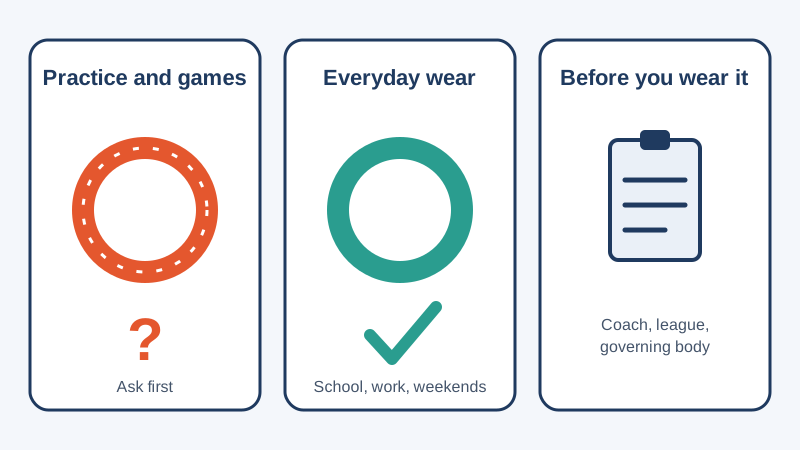
Can you wear a sports ring to practice and games?
The honest answer is: it depends, and the decision belongs to your coach, your league and the rule book for your sport, not to a jewelry company. Many sports and many levels of play have rules or customs that restrict jewelry during competition. Some require that rings be removed. Some allow certain items under specific conditions. Rules also change over time and differ between youth leagues, school sports, travel teams, recreational leagues and adult leagues.
Because we cannot know which rule applies to your team, we do not tell athletes that a sports ring is allowed in play. Instead, we suggest a simple default: treat a ring as an off-the-field item until someone with authority tells you otherwise.
Why jewelry is a common concern in sports
Without citing any specific rule, the general reasons are easy to understand. Sports involve contact, equipment, grabbing, catching, sliding and falling. A ring can catch on a jersey, a net, a glove, a ball, another player's hand or a piece of equipment. Officials, coaches and athletic trainers tend to be cautious about anything that might snag or injure a player or an opponent. That is why the question is worth asking even for a soft silicone ring.
A safe default for practice
Practice is usually run by your coach, which makes it the easiest place to ask. Bring the question directly: "I have a silicone sports ring for this sport. Is it okay to wear it at practice, or would you like it in my bag?" Coaches appreciate athletes who ask rather than assume. If the answer is no, you have lost nothing. Slip the ring into a pocket of your gear bag and put it back on afterward.
A safe default for games
Game days add officials, league administrators and sometimes tournament directors to the mix. If your coach is not sure, ask them to check with the league or the officials before game day, not at the moment of warm-ups. If you do not get a clear answer, leave the ring off during play and wear it before and after. The ring is a keepsake and a way to show pride. It is not worth a penalty, a disagreement with an official or a missed game.
The table below summarizes a cautious approach. It does not describe any rule. It describes a habit.
| Situation | Cautious default | Who to ask |
|---|---|---|
| Team practice | Ring off unless your coach says yes | Head coach or assistant coach |
| Scrimmage or friendly | Ring off unless clearly permitted | Coach, and the officials if present |
| Official league game | Ring off in play unless the rule book or an official allows it | Coach, league office, officials |
| Tournament or showcase | Ring off in play unless the event organizers say otherwise | Tournament director or event rules |
| Warm-ups, bench and sidelines | Ask your coach; team rules often cover these too | Coach or team manager |
| Before and after play, travel, team events | Wear it and enjoy it | No one, unless your team has a dress code |
What league and governing-body rules should you check?
This is the part where we want to be especially clear: we are not going to tell you what your rule book says. Rule books are written and updated by leagues and governing bodies, and the text can change from season to season. The right move is to read the current version for your sport and level, or ask someone who has.
Who sets the rules for your team?
The answer depends on where you play. Here are the common layers, from closest to farthest from the field.
- Your team or club: team rules, dress codes, travel policies and coach preferences.
- Your school or athletic department: policies for school-sponsored teams, including anything the athletic director or athletic trainer requires.
- Your league or conference: local, regional or recreational leagues often publish their own rules or add local rules on top of a national set.
- Your state or regional association: many school sports follow state association rules.
- A national governing body or rule-making organization: for example, national federations and associations publish playing rules for many sports. Examples include the National Federation of State High School Associations (NFHS) for much of high school sport in the United States, and the NCAA for college sports.
- Event organizers: tournaments, showcases and camps can have their own conditions of play.
You do not need to read every layer. Start with the closest one, your coach, and work outward only if the coach is unsure.
Questions worth asking
When you talk to a coach, athletic director or league contact, specific questions get faster answers than a vague one. Try these.
- Does our league or association have a rule about jewelry during play? Where can I read it?
- Does that rule apply to practice, warm-ups and the bench, or only to games?
- Is there any exception, for example for medical or religious items? (Do not assume. Ask.)
- Who makes the final call on game day, the officials or the coach?
- If the answer is no, is there a place on the bench or in the bag where I can keep it safely?
- Does our team have a dress code for travel days, banquets or team photos where a ring would be fine?
Write down the answer, and if it is important, ask for it in writing, such as an email or a link to the rule. That way, if another coach or official asks about it, you can point to the source.
For a related read on selecting items that are safe to hand out to a whole team, see our guide to coach and team gift ideas.
What should you wear to practice and games?
Beyond the ring question, athletes often wonder how to think about accessories overall. A good general approach is to follow the dress code for your team first, wear what keeps you comfortable and safe, and leave the extras for before and after.
At practice
- Follow your coach's instructions on jewelry, accessories and anything that could catch.
- Keep a small zip pouch or the inside pocket of your gear bag for rings, watches and earrings you take off before practice.
- Take your ring off before you put on gloves, wraps or tape, not after. It is easier, and it avoids the risk of losing it in the process.
- If your sport involves a lot of hand contact, grabbing or equipment, make removing the ring a habit as automatic as tying your shoes.
On game day
- Wear the ring to the venue if you like. It is a nice part of a game-day routine.
- Before warm-ups, ask your coach whether the ring stays on, comes off or goes into the bag.
- Do not hand a ring to a teammate to hold unless you are sure it will come back. Bag pockets are safer than pockets of borrowed hoodies.
- After the game, put it back on. Many athletes like the ritual of putting on the ring at the end of a game as a small way to mark a good effort, win or lose.
Sport-by-sport thinking (without guessing at rules)
Every sport has its own movement patterns, and each raises its own question about jewelry. We list them here as prompts for a conversation with your coach, not as rules.
| Sport | Why people ask | Good question for your coach |
|---|---|---|
| Football | Lots of contact, gloves and equipment | Does the league require removal of all jewelry for practice and games? |
| Baseball | Gloves, sliding, batting gloves and grips | Is a ring okay under gloves, or should it stay in the bag? |
| Softball | Fielding, sliding and batting gloves | Does our league's rule treat rings differently from necklaces or bracelets? |
| Basketball | Contact under the basket, catching and ball handling | Do the officials in our league ask players to remove rings before tip-off? |
| Soccer | Contact, heading and slide tackles | Is jewelry checked before matches, and what does the referee expect? |
| Golf | Grip on the club and gloves | Is it a comfort issue only, or does the event or club have a policy? |
| Volleyball | Blocking, digging and net contact | Do our officials or league have a stance on rings near the net? |
The pattern is the same across all of them. Ask, listen, and follow the answer.
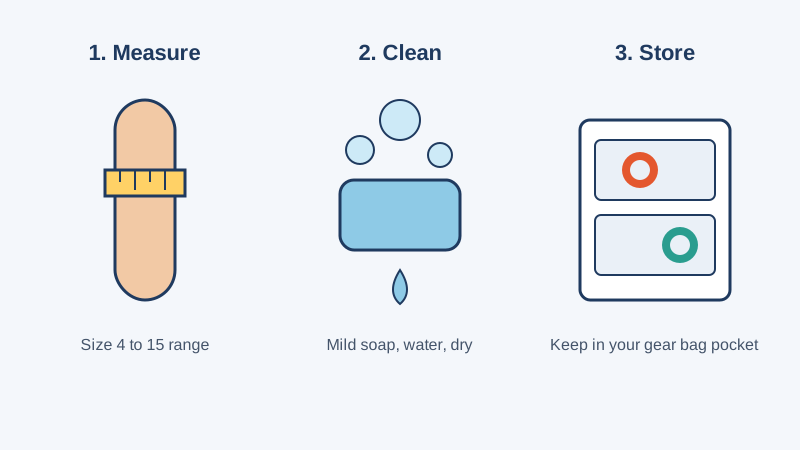
How do you wear a sports ring every day?
This is where a silicone sports ring is at its best. Away from practice and games, it is simply a colorful, comfortable ring with a sport on it. Here are practical tips for wearing one around school, work, errands and weekends.
Get the size right
Gameday Global rings are available in sizes 4 through 15. A ring that is too tight is uncomfortable, and a ring that is too loose can slide off. If you already know your size from another ring, you can start there. If you do not, use a ring sizer or a printable sizing chart from a jeweler, measure at the end of the day when your hands are at their normal size, and keep in mind that the base of a finger and its knuckle may differ. If you are between sizes, many people choose the slightly larger size for comfort. If you are buying as a gift and cannot ask, our gift guides cover how to handle that question without spoiling the surprise.
Keep it comfortable in school and at work
- Silicone is lightweight, so most people forget they are wearing it. If you notice irritation, take it off and let the skin rest.
- Rinse and dry your hands and the ring after using soap, lotion or sanitizer. Residue can collect under a ring.
- If you work with machinery, tools or anything that can catch a ring, take it off first. Follow your workplace or school safety instructions.
- If you have sensitive skin or a known sensitivity to any material, check the product description, and ask your doctor if you have concerns about your own skin.
How do you clean and store a silicone sports ring?
Silicone is simple to look after, which is part of its appeal. These are general care tips that apply to most silicone accessories. If a product includes its own care instructions, follow those first.
- Wash it with mild soap and warm water. A soft cloth or your fingers are enough.
- Rinse thoroughly so no soap residue remains, which can feel sticky against the skin.
- Dry with a clean towel or let it air dry before putting it back on or storing it.
- Avoid leaving it in a hot car, direct sun for long periods or near open flames or very high heat.
- Keep it away from sharp objects, which can nick or cut silicone.
- Store it flat or in a small pouch, away from loose items that might scratch or press on it.
If a ring is damaged, torn or no longer fits well, stop wearing it. Contact the seller for help. For Gameday Global products, you can reach us at [email protected].
How do you choose the right ring for the right athlete?
If you are buying for yourself, pick the sport you play or love most. If you are buying for someone else, here are a few simple ideas.
- Match the sport. The rings are available as football, baseball, softball, basketball, soccer, golf and volleyball designs. A baseball ring for a softball player or the other way around is an easy mistake, so double-check.
- Consider the whole team. A ring can be a small, inexpensive keepsake for a season, an end-of-year banquet or a senior night. Our guide to coach and team gift ideas covers ways to put a team order together.
- Think about size ahead of time. Sizes 4 through 15 cover a wide range, but only if you know which one to pick. Ask a parent or friend, or choose a size based on a ring the person already wears.
- Do not forget the rules. If the gift is for an active player, a quick reminder that the ring is for off-the-field wear unless the coach says otherwise keeps everyone out of trouble.
Individual rings retail for $29.99 at gameday.best. You can browse the sport designs and size range there.
Can a team, club or shop order sports rings in bulk?
Yes. Gameday Global offers wholesale pricing for retailers, sporting goods stores, boosters, clubs and anyone planning to resell. Wholesale starts from $9.00 per ring through a starter case that includes a free countertop display, with pricing at $8.00 per ring on orders of five or more cases. If you want rings in time for Black Friday, orders are due by November 6, 2026. Details are on the wholesale page.
A note for coaches, boosters and organizers: if you plan to use rings as team gifts or fundraiser items, check your league, school or club policy on gifts, fundraising and equipment first. As with jewelry in play, the rule is that the governing authority decides, not the vendor.
Key takeaways
- Treat a sports ring as an off-the-field item unless your coach, league or governing body clearly says it can be worn in play.
- Jewelry rules differ by sport, level and organization, and they change, so check the current rule book or ask someone with authority.
- Start with your coach, then work outward to the league, association or event organizers if needed.
- Ask specific questions: does the rule cover practice, warm-ups and the bench, and who decides on game day?
- Silicone is lightweight and comfortable for everyday wear: school, weekends, travel days and team events.
- Choose the right size (4 to 15 are available), clean with mild soap and water, and store it in a dedicated spot.
- Never argue with an official about a ring. Take it off and move on.
Frequently asked questions
Can I wear a silicone sports ring during a game?
It depends on your sport, league and level. Many rule sets restrict jewelry in play, and rules change, so we cannot say yes or no for your team. Ask your coach, and have them confirm with the league or officials if they are unsure. Until you have a clear answer, keep the ring off during play and wear it before and after.
Is it okay to wear a sports ring at practice?
Practice rules are usually set by your coach, so ask them directly. Some coaches are relaxed and some require all jewelry to be removed. A simple question, such as asking whether the ring should stay on or go in your bag, settles it quickly. If the answer is no, keep the ring in a pocket of your gear bag.
Who decides whether jewelry is allowed in my league?
The answer depends on where you play. It may be your coach, your school's athletic department, a local league, a state association, a national governing body or the officials on game day. Start with your coach and ask where the written rule is. If your coach is unsure, ask the league office or event organizers.
What sizes do Gameday Global sports rings come in?
The 3D silicone sports rings are available in sizes 4 through 15. If you do not know your size, measure your finger at the end of the day when your hands are at their normal size, or use a printable ring sizer from a jeweler. If you fall between sizes, many people choose the slightly larger one for comfort.
How do I clean a silicone sports ring?
Wash it with mild soap and warm water, rinse away any soap residue and dry it with a clean towel or let it air dry. Avoid sharp objects and extended exposure to high heat, such as a hot car. If your ring came with its own care instructions, follow those first.
Can I wear a sports ring every day?
Most people wear silicone rings daily for school, work and weekends. Take it off if it feels tight, if your skin gets irritated or if you are using tools or equipment that could catch it. Rinse and dry your hands and the ring after using soap or lotion. If you have skin concerns, talk with your doctor.
What sports do the rings come in?
Gameday Global makes 3D silicone rings in football, baseball, softball, basketball, soccer, golf and volleyball designs. You can browse them all at gameday.best. If you or a family member plays more than one sport, you can pick a ring for each and rotate them depending on the season.
Can my team or shop buy sports rings in bulk?
Yes. Wholesale starts from $9.00 per ring through a starter case with a free countertop display, and $8.00 per ring on five or more cases. To have rings in time for Black Friday, order by November 6, 2026. Details and ordering are available at gameday.best/wholesale.
Sources
- National Federation of State High School Associations (NFHS): Publishes playing rules for many high school sports in the United States. Check the current rule book for your sport.
- NCAA: Governing body for college athletics. Check the current rules for your sport and division.
- Gameday Global: Product information, sizes and designs.
- Gameday Global wholesale: Wholesale pricing and ordering information.
We list governing bodies here only as places to look up current rules. We have not quoted or summarized any of their rules, and nothing in this guide should be read as a statement of what any of them require.